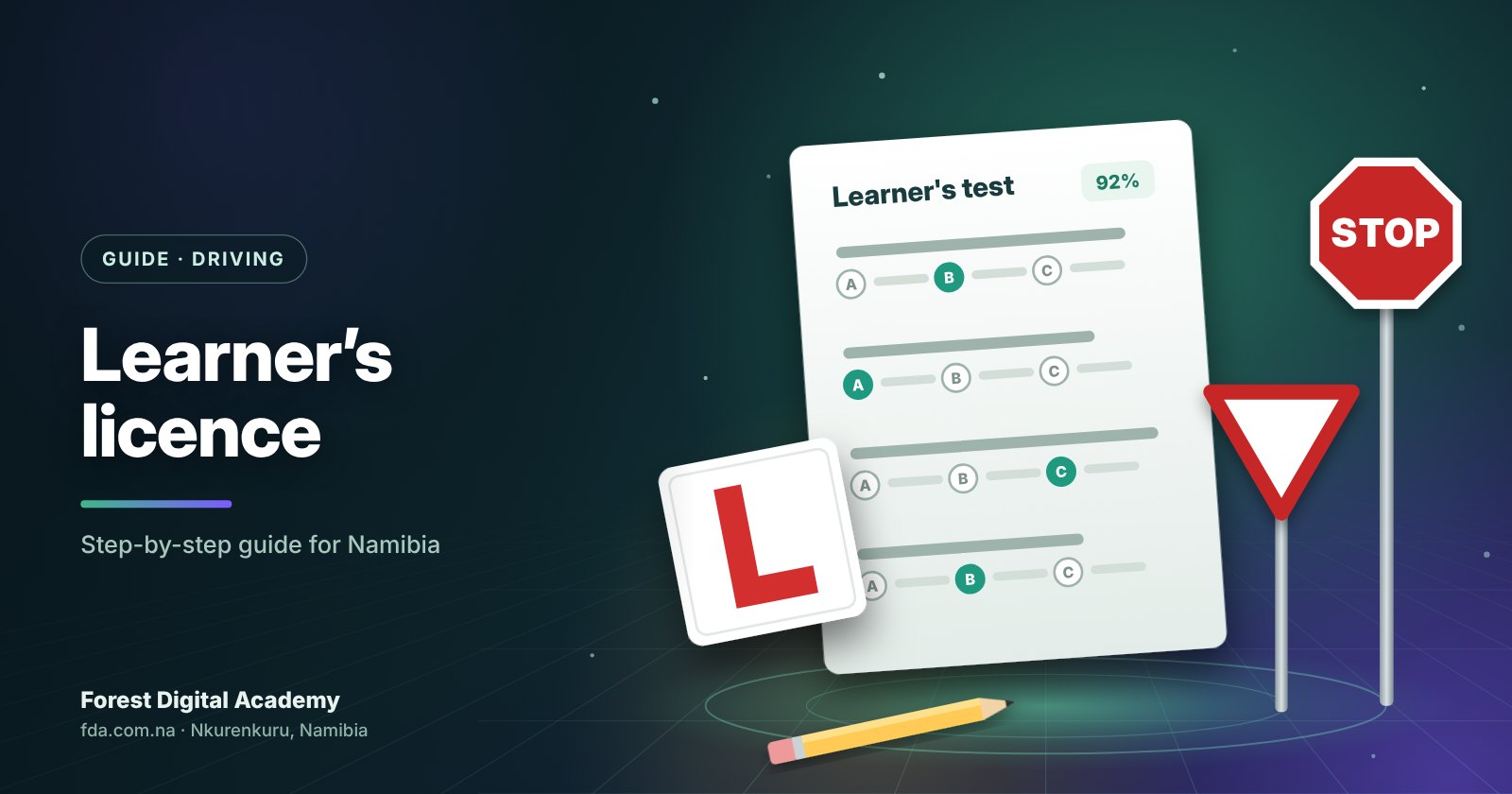
Quick answer: You apply for a learner’s licence at a NaTIS office run by the Roads Authority. You need to be old enough for the code you want, pass an eye test and then pass a multiple-choice theory test. Once you pass and pay the issuing fee, your learner’s licence is valid for 18 months.
- Minimum age: 16 for Code 1 (motorcycles up to 125 cc), 17 for Code 2 (cars and light vehicles), 18 for Code 3 (heavy vehicles).
- Bring a completed application form and a certified copy of your Namibian ID (or your traffic register number).
- Fees listed by the Roads Authority: N$45 to apply (test included) and N$50 to issue the licence.
- The test covers road signs and markings, the rules of the road and the controls of the vehicle type you are applying for. A computerised version is being rolled out to all NaTIS centres by March 2027.
- While learning in a car or truck, a driver licensed for that vehicle must sit next to you. Motorcycle learners ride without a supervisor but may not carry a passenger.
Practise for free first: Tuvawawa Driving Academy’s free learner’s course covers road signs, rules of the road and vehicle controls for Codes 1, 2 and 3, with quizzes and timed mock papers. Start free learner’s practice →
A learner’s licence is your first official step towards driving in Namibia. It shows you know the road rules and lets you practise on public roads with a licensed driver beside you.
This guide walks you through the process at NaTIS (the Namibia Traffic Information System offices run by the Roads Authority), including what the test looks like in 2026 and what it costs.
Which learner’s licence code do you need?
Learner’s licences come in three codes. Pick the one for the vehicle you want to drive, because you can only take the driving test for a class your learner’s licence covers.
| Learner’s code | Vehicles | Minimum age |
|---|---|---|
| Code 1 (A1, A) | Motorcycles | 16 (A1, up to 125 cc). Some sources say 17 for larger motorcycles (A), so check with NaTIS. |
| Code 2 (B, BE) | Cars, bakkies and other light vehicles up to 3,500 kg | 17 |
| Code 3 (C1, C, C1E, CE) | Heavier vehicles above 3,500 kg, such as trucks | 18 |
Most school-leavers want Code 2, which leads to the Code B licence for ordinary cars. You must already be 17 on the day you apply. Applicants older than 65 also need a valid medical certificate.
What to bring to NaTIS
- Application form: available at the NaTIS office. Fill it in neatly and completely.
- Proof of identity: a certified copy of your Namibian ID. Non-citizens use a traffic register number. Past Roads Authority notices asked for copies certified at the Namibian Police, so plan for that.
- Your original ID for the day of the test.
- Glasses or contact lenses if you wear them, for the eye test.
- Money for the fees (see the table below).
- Photos, if asked: the regulations call for two photos only where the office cannot take your picture digitally. Ask your office whether you need them.
Tip: If you are in Nkurenkuru and need copies of your ID or passport photos before your NaTIS visit, Tecover Printing Café can help. Remember that the certification stamp itself must come from the police or another commissioner of oaths.
Step by step: from application to licence
- Study first. Get the Namibian learner’s and driving licence manual and work through it before you book.
- Apply at a NaTIS office. Hand in your form and ID copy so the office can check your age and documents.
- Do the eye test. NaTIS checks your eyesight with an approved machine. If you fail, the regulations let you get a second test from a registered optometrist or eye specialist at your own cost. An eye test result lapses after six months if you have not passed the theory test by then.
- Pay and get your test date. The Roads Authority says bookings are taken daily at NaTIS Valley in Windhoek, Swakopmund and Oshakati, and that other centres should be contacted directly. You receive your test date once you have paid.
- Write the test. Arrive early with your original ID and booking proof. Phones and books stay out of the test room.
- Collect your learner’s licence. After passing, pay the issuing fee and receive your licence.
The Roads Authority is also rolling out an online Book and Pay system, launched with the computerised test in June 2026. Check the NaTIS Online portal or ask your office whether it covers your centre yet.
What the learner’s test covers
The test is multiple choice and is based on an approved Namibian manual. Expect questions on road signs, road markings and the rules of the road, such as who has right of way, speed limits, overtaking and what to do at intersections.
There is also a short vehicle-controls section for your code: motorcycle controls for Code 1, and car and truck controls for Codes 2 and 3, which share the same section. Questions ask things like which control you use to change gear, dip your headlights or keep a parked vehicle from moving.
Use Namibian study material, not a South African K53 book. Namibia’s rules come from its own Road Traffic and Transport Act of 1999 and its regulations. In August 2026 the Ministry of Works and Transport said it was reviewing the computerised question bank to align it fully with Namibian law.
Paper test or computer test?
Namibia is replacing paper tests with a computerised learner’s licence test. It was piloted at the Okahandja NaTIS centre from May 2026 and officially launched there in June 2026. Gobabis, Karibib and Keetmanshoop are next, and the government plans to have all 43 NaTIS centres using it by March 2027.
On the computer test, the ministry says the exam takes about 30 minutes and you get your result immediately. You first see four practice questions to get used to the system. Webcam monitoring, identity checks and randomised questions are used to stop cheating.
The Roads Authority does not publish the number of questions or the pass mark online. For the paper test, a 2017 regional review of Namibia’s licensing system reported 79 questions for Codes 2 and 3 and 75 for Code 1, to be finished in 90 minutes with at least 80% to pass, and Namibian press reports have also mentioned 80%. The new computerised test is shorter, about 30 minutes, and its question count and pass mark have not been published, so confirm at your office. Practice papers, including Tuvawawa’s free ones, are for preparation only and are not the official test. Between May and July 2026 only about 43 to 45% of candidates passed nationally, so prepare thoroughly.
English is the main test language. Tests in local languages such as Rukwangali were offered from 2021, but the Roads Authority put them on hold in 2025 because very few people used them.
How much it costs
| Item | Fee |
|---|---|
| Learner’s licence application (test included) | N$45 |
| Issuing the learner’s licence after you pass | N$50 |
| Duplicate learner’s licence if yours is lost | N$30 |
These amounts appear on the Roads Authority website (October 2026); the application and issuing fees took effect on 1 June 2023. Confirm at your NaTIS office, and budget extra for copies and transport.
How to study so you pass
- Learn signs by group. Sort them into warning, regulatory and information signs, and notice what shape and colour tell you.
- Read every word. Many wrong answers come from missing one word, such as “may” versus “must”.
- Quiz yourself daily. Cover the meaning and say it out loud, or ask a friend to test you.
- Practise against the clock. The computer test is timed, so do timed practice rounds.
- Keep sessions short. Thirty focused minutes a day for a few weeks beats one long night before the test.
After you pass: the rules for learner drivers
A learner’s licence does not let you drive alone. Windhoek City Police have reminded the public that a fully licensed driver must be in the vehicle with a learner at all times, and warned that breaking this rule can lead to a fine of N$1,000. Carry your learner’s licence whenever you practise.
Your learner’s licence is valid for 18 months. If it expires before you get your driving licence, you must apply and write the test again, so start practical lessons early.
If you fail the test
Failing is common, so do not lose heart. You will need to book and pay the application fee again. Use the waiting time to study the areas you found hardest.
A note for Kavango West residents
The NaTIS office in Nkurenkuru offers the learner’s licence test, so you do not need to travel to Rundu for it. Visit or phone the office first to book your test date and confirm what to bring.
Frequently asked questions
Can I get a learner’s licence for a car at 16?
No. For Code 2 (cars and light vehicles) you must be at least 17 when you apply. At 16 you can only apply for the motorcycle code.
How long is a learner’s licence valid in Namibia?
The regulations set it at 18 months. If it runs out before you pass your driving test, you start the learner’s process again.
Can I write the test in Rukwangali?
Local-language tests were put on hold in 2025 because of low demand. Ask your NaTIS office whether they are available again.
What happens if I lose my learner’s licence?
You can apply for a duplicate at NaTIS. The Roads Authority lists the fee as N$30.
Sources and official links
- Roads Authority: Driver’s licence, learner’s licence and fees
- NaTIS Online (Roads Authority)
- Road Traffic and Transport Regulations amendments, Government Gazette 2815 (Legal Assistance Centre)
- The Namibian: NaTIS raises service charges (2023)
- The Namibian: Okahandja starts computerised learner licence test (2026)
- Windhoek Express: New learner’s licence system records 14% pass rate (2026)
- The Namibian: Learner’s licence pass rates trigger test review (2026)
- The Namibian: Local-language learner’s tests on hold (2025)
- The Namibian: Learner licence tests in local languages (2021)
- New Era: City Police advisory for learner drivers (2025)
- The Brief: Additional N$25m for nationwide rollout of computerised licence testing (2026)
- The Brief: NaTIS to launch computerised learner exams and online booking (2025)
- New Era: Age limits for obtaining a licence
- The Namibian: Learner’s licence trials and tribulations (2019)
- Tripartite Transport and Transit Facilitation Programme: Namibia legal and institutional review (February 2017, PDF)
Last checked: 15 October 2026. Rules, dates and fees can change, so always confirm with your NaTIS office before you go.