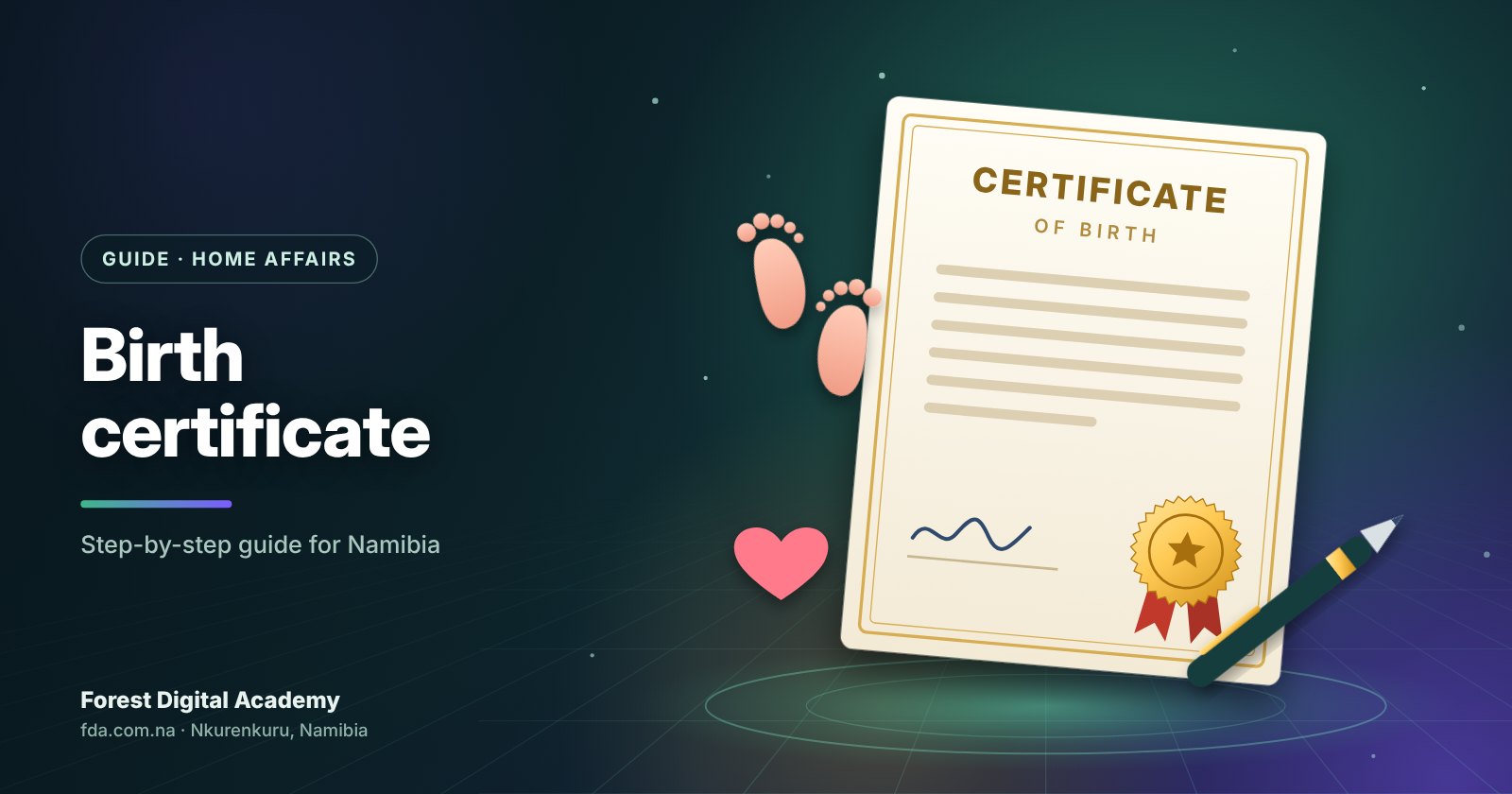
Quick answer: Register your baby at a Home Affairs office, or at the Home Affairs desk in the hospital if there is one, as soon as possible after the birth. Registration and the first birth certificate are free, even if you register late. Take the baby’s proof of birth (such as the yellow health card) and the parents’ IDs or birth certificates.
- The law asks parents to give notice of a birth within 14 days; registration within the first year counts as normal registration.
- After one year, it becomes a late registration. It is still free but needs extra paperwork.
- A mother can register her child even if the father is absent; his details can be added later.
- Ask for a full birth certificate. Converting an abridged one to a full one is free.
- Replacement copies cost N$100 for the first, rising by N$100 each time to N$500 (ministry fees, checked October 2026).
A birth certificate is the first official document your child will ever have, and almost every other document is built on it. Without one, getting an ID at 16, a passport or a child grant becomes very difficult.
Kavango West has had some of the lowest birth registration rates in Namibia. When the new regional Home Affairs office in Nkurenkuru was opened in March 2026, the President said the region’s rate stood at about 77% in the 2023 census, compared with a national figure of about 87%. This guide shows you how to make sure your child is counted.
How soon must you register?
Births are still registered under the Births, Marriages and Deaths Registration Act of 1963. It says a birth should be reported to the registrar within 14 days. In practice, the ministry treats any registration before the child turns one as a normal registration.
Once a child is more than a year old, the law requires special permission, and the ministry calls this a late registration. It is still free, but it involves more checks and can take longer.
A new law, the Civil Registration and Identification Act of 2024, will set different time limits when it starts. It had not come into force by October 2026, so follow the current rules and simply register early.
Where to register
- At the hospital. In December 2025 the ministry said it had placed staff in 24 state hospitals to register babies straight after delivery, and that 126 hospitals now report births electronically. Before you leave hospital, ask whether there is a Home Affairs desk.
- At a Home Affairs office. In Kavango West, the regional office in Nkurenkuru handles birth registration. You can also use your nearest Home Affairs office.
- During outreach campaigns. The ministry runs mobile registration drives in rural areas from time to time. Listen out for announcements on the radio or from your councillor’s office.
Documents to take
| Document | Normal registration (under 1 year) | Late registration (over 1 year) |
|---|---|---|
| Registration form | Notification of Birth form (from the office) | Application for Late Registration of Birth (from the office) |
| Proof of birth | Yellow health card or other proof of birth from the hospital or clinic | Same |
| Parents’ documents | Certified birth certificate, ID or passport of each parent to be named | Same |
| Marriage certificate | If the parents are married | Same |
| Consent affidavit | For a parent who wants to be named but cannot attend | Same |
| Non-Namibian parent | Passport and proof of Namibian immigration status | Same |
| Fee | Free | Free |
Step by step
- Choose your baby’s name. The law does not allow a birth to be registered without a name, so agree on it before you go.
- Gather the documents in the table and make certified copies of the parents’ IDs or birth certificates.
- Go to the hospital desk or a Home Affairs office. Parents should go in person, because the forms are signed by the parents.
- Fill in and sign the form. Check every spelling and date before you sign. Fixing a mistake later can cost money.
- Collect the certificate. Hospital desks are meant to issue certificates soon after delivery. At an office, ask when to come back, and keep any receipt you are given.
Tip: Once you have the certificate, make copies and keep a scan in your email or on your phone, and store the original somewhere dry. FDA’s studio in Nkurenkuru can copy and scan documents while you wait.
If the father is not there
An absent father is no reason to delay. At the Nkurenkuru office opening in March 2026, the President said mothers must not be turned away when the father is absent, and that the child may carry the mother’s surname. The father’s details can be added later.
If the father wants to be named but cannot attend, he can sign an affidavit of consent, which you take along with a certified copy of his ID. Adding his details later is called re-registration. For a child aged six or older, the ministry’s fee list sets this at N$200.
Babies born at home
Take the mother and baby to a clinic or hospital soon after the birth, so the baby is checked and the birth is recorded. The ministry has also said that, for a home birth, a person who witnessed the birth can make a declaration as proof. Ask your office exactly which declaration it needs.
Late registration
If your child, or you as an adult, was never registered, you can still apply. Use the late registration form and take the same documents as above. Proof of birth is the hardest part for older people, so take whatever you have, such as a clinic card or sworn declarations from people who know the facts. Ask the office what it will accept before you travel.
Late applications get extra checks, so they can take longer. Do not leave it until a few weeks before your child needs an ID or a passport.
Full or abridged certificate?
Namibia issues two versions. The full birth certificate is the longer version, which usually shows the parents’ details. The abridged certificate is a shorter version. Some authorities accept only the full one: the UK passport office is an example, and Namibian embassies ask for a full certificate when citizens abroad apply for an ID. The ministry converts an abridged certificate to a full one free of charge, so ask for the full certificate from the start.
Copies, corrections and fees
| Service | Fee (ministry, checked October 2026) |
|---|---|
| Birth registration and first certificate (including late) | Free |
| Converting abridged to full certificate | Free |
| Duplicate (replacement) certificate | N$100 (1st), N$200 (2nd), N$300 (3rd), N$400 (4th), N$500 (5th and later) |
| Correcting a mistake you made on the form | N$200 |
| Adding the father’s details (child aged 6 or older) | N$200 |
| Changing a child’s first name or a minor’s surname | N$200 |
For a duplicate, fill in the duplicate application form and take a copy of the old certificate if you have one.
Why the birth certificate matters
- ID card: you need your birth certificate to apply for your ID at 16.
- Passport: every passport application asks for a birth certificate.
- Child grants: the government’s maintenance grant asks for a certified copy of the child’s birth certificate.
- Travel: border officials may ask for a child’s full birth certificate when the child crosses a border.
Frequently asked questions
Does it cost anything to register a birth?
No. Registration and the first certificate are free, even for late registration. You only pay for duplicates and some changes.
Can a grandmother register a child?
Usually not on their own. In 2024 the ministry said only the biological parents may sign the registration form. If the parents have died or cannot be found, ask the office what it needs in your situation.
We lost our child’s birth certificate. What now?
Apply for a duplicate at any Home Affairs office. The first one costs N$100.
Is the birth certificate from the hospital desk the real one?
Yes. Home Affairs staff at hospitals issue the official certificate, the same as an office would.
Sources and official links
- Ministry of Home Affairs, Immigration, Safety and Security: Birth registration and information
- Ministry of Home Affairs, Immigration, Safety and Security: Application fees
- Births, Marriages and Deaths Registration Act 81 of 1963 (NamibLII)
- Civil Registration and Identification Act 13 of 2024 (NamibLII)
- The Namibian: Home Affairs deploys staff to 24 hospitals (December 2025)
- NAMPA: President urges parents to register newborns without delay (March 2026)
- The Namibian: Birth registration without both parents (April 2026)
- The Namibian: Ministry on parents and proof of birth (March 2024)
- UK Government: Namibia knowledge base profile (full and abridged certificates)
- Maintenance grant requirements
Last checked: 10 October 2026. Rules and fees can change, so always confirm with your nearest Home Affairs office before you go.